
Take Care
Notes From February/March

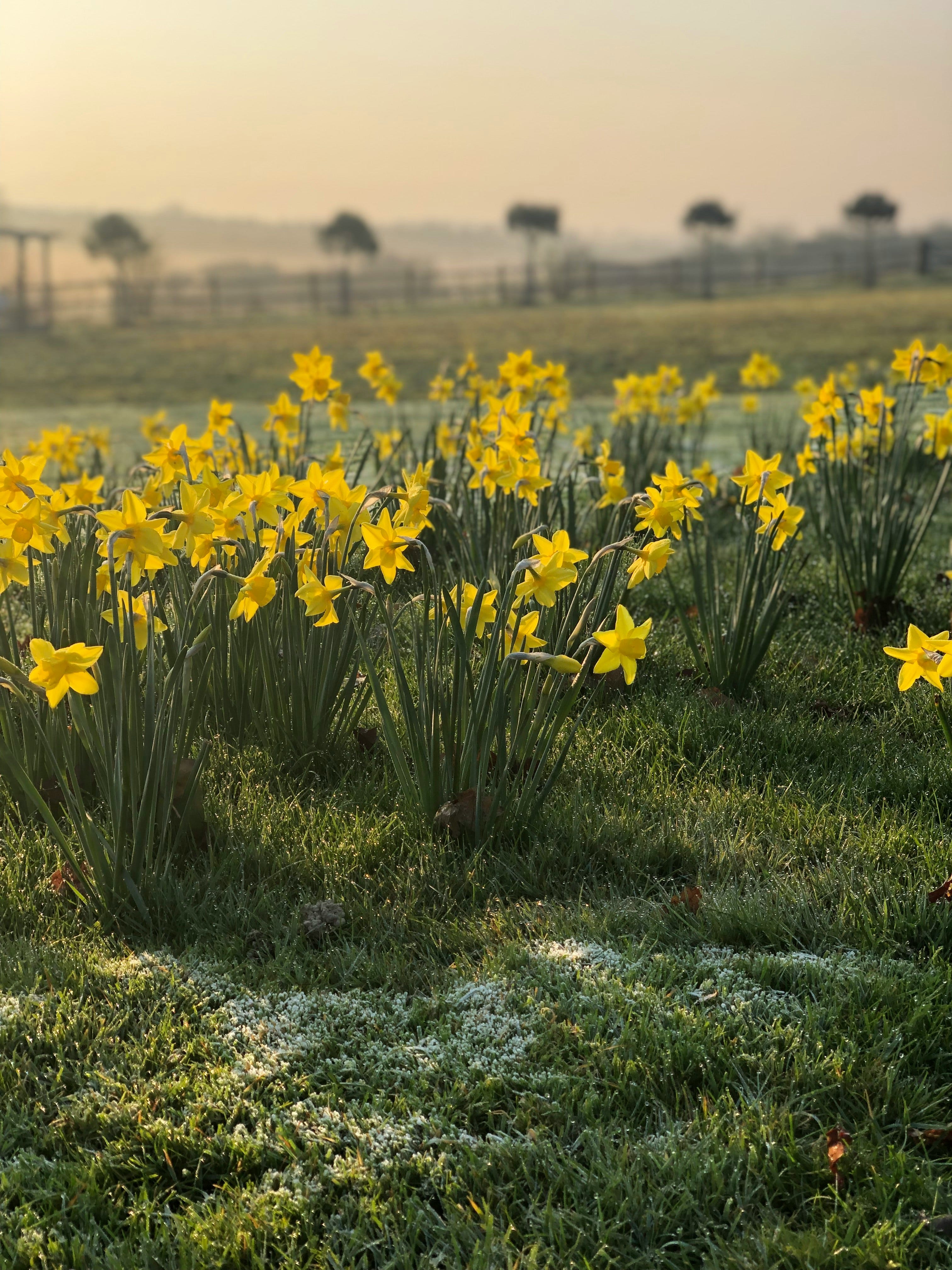
The tenth of February, and the snow blanket finally begins to melt. I spot tiny green nubs in the black soil of the front garden. The daffodils. I point them out to my son, excitedly. How could it be this time again? I remember standing in this very same place on the porch last year; I remember how I smiled when I saw those spots of new green.
For the first time in my life, it seems that winter has passed me by quickly, as if the spinning wheel of the seasons is whirling faster and faster. In Bible study group this morning, a woman talked about having her parents over for dinner and watching her mother play with the children, while thinking, “You were just my mother. And now you’re my own children’s grandmother? Where did these children come from anyway? They’ve just appeared around me! One, two, three of them! Was I ever even pregnant?!”
And so it goes. I feel the same surprise when my daughter combs my hair in the evening, moving the brush the wrong way, insisting she’s getting the tangles out—I remember combing my own mother’s hair years and years ago, styling it with rainbow-colored hair elastics and butterfly clips.
Sometimes the speed of time is comforting; it means that no hard season lasts forever. And sometimes it is bittersweet, because one day will come when I am not the one standing on this porch marveling over a half inch of daffodil bud, and perhaps whoever is here after me will not witness this, will miss it, will even try to destroy this garden.
Funny how it is not the thought of my own absence that disturbs me. I am disturbed, instead, that there might be an absence of care for what I leave behind.
********************
Driving home one afternoon from physical therapy, I am thinking about my writing process and its torturous slowness. And I am frustrated—why can’t I produce more quickly, like so many other writers do? Ideas and essays percolate in my mind for weeks, months, even years.
I am like a mole, feeling his way through the earth, considering the pathways of sentences, paragraphs, thoughts, with his velvety hands. Shall I go this way? Use this word? Or this one? Explore this angle? Which way is the way to the light?
Last year a woman I was interviewing asked me if I feel a sense of urgency to write about abuse in Mennonite communities. I told her, yes, yes I do. And I still do. But yet my brain does not work with urgency. I joke sometimes to myself that my thoughts are set at 0.5 speed.
My grandmother, too, used to joke about her slow brain. And then she would say: “But it takes all kinds of people to make a world go round.” She repeated that phrase often in our meandering conversations. It takes all kinds of people.
**********************
February 18 – Ash Wednesday.
In the warm glow of a church, I sit with a small group of people. Together, we sit and we kneel, stand and recite, sing and file forward for the bread and the wine. In a service like this, participation is demanded. It is even uncomfortable—“passing the peace” with total strangers is not my activity of choice. We confess our sins together, begging God: “Spare your people, O Lord, and do not make your heritage a mockery, a byword among the nation. Why should it be said among the peoples, ‘Where is their God?’” (Joel 2:17). We receive the mark of our mortality, the mark of our hope together, all together. Even a chubby baby in his grandmother’s arms receives the ash on his fresh skin.
Then, kneeling at the rail with the others, my hands cupped and open to receive, I think of the homily the presiding Reverend gave, about how the ashen cross is a symbol of sin and death, yes, but it is more than that.
His voice was quiet, earnest, as he explained: “Ha’adamah is the Hebrew word for the dust of the ground. And God called ha’adam—mankind—out of the ha’adamah. He took the dust, kissed it”—here he takes his hand and swoops it through the air as if gathering dirt, makes a fist, and brings it to his lips—“He kissed it with His breath of life. And so, the ash is not only a symbol of sin and our grief over sin, but also a symbol of God’s intimacy with humanity. He longs to be with us, in us. He promises He will be with us and in us.”
The Reverend went on to speak of the Eucharist, how Jesus broke Himself open to offer Himself to us, and we receive the gift of His presence in our bodies as we open our mouths for the bread and the wine.
And so, as the thick brown bread crumbles in my mouth and the bitter wine explodes across my tongue, I am thinking of God’s desire for relationship, and my desire for him, and how Christ is here. Christ is with me, Christ is in me, He is around me. I close my eyes and for a long moment, I can’t move. I want to sob. I want to stay here kneeling with the bitterness of bread and wine in my mouth for hours.
************************
March 1st.
Things that are precious to my son right now: a broken key chain, a miniature rescue boat, and a small smooth rock.
Things my daughter does right now that I love: pats my cheek with her small hand, giggles when I kiss her, draws with a marker ever so carefully in her little brown book.
*************************
The fifth of March. I drive south toward where I grew up. Along the long stretch of interstate bordered by woods, a gray sky hangs low. The trees are wet, mottled black and slime green, like strange stick toads. Above those trunks, a canopy of branches crowns the wood. And these branches are sprinkled with a color that I try to pinpoint as it blurs through the windows of the van. It is like blood, like deep purple, like royalty.
All of these colors—black, purple, red, brown, that slimy green that shifts in shades—bring to mind the woven blankets my grandmother used to buy as graduation presents for the grandchildren. These blankets were purchased from Amish stores, the clean, tidy places to buy everything from bread flour to souvenirs. She brought me along to pick out my blanket. The sunshine shifted across swept wooden floors, and every store we stopped, she would have a conversation with the man or woman at the counter: “Yes, my husband’s name was —. Oh, you know —? I have a cousin —. And you are —?”
I don’t remember when I began to resent the specificity of these conversations, of names and relations pinned to my face, of being swiped and slotted into a card file in another person’s mind, along with one or two quick judgments.1 Probably it happened sometime when I was pregnant with my son, when I swung from an extreme extroversion to a painful introversion. But now, when someone fishes after my parent’s names, I wince. When someone recognizes me, I feel like dodging under a table. I debated using a pseudonym online, and I still might in the future.
The daffodils in my garden are noticed and loved at every stage of their development, from the tiniest finger of green until they bloom in a triumphant trumpet of yellow. Me, though? I will always be at the wrong stage of growth for someone, for many people. And so I hide, seek the crowds where I walk through ungreeted and unknown, or the groups where there is no context for where I have come from and where I might be going. The groups where I just am. I just talk, listen, laugh, ask questions. No one expects me to be a golden flower; no one wishes I were back in the ground.

Things out there in the world I’ve enjoyed lately:
I just completed a reading group on Virginia Woolf’s Mrs. Dalloway with the Catherine Project, and I absolutely loved the experience. If you’re a bookworm and love discussing books with other people, please check out all their reading groups! And sign up to get the email when enrollment happens again. Like mentioned above, it’s one of those groups where you simply show up, and the only expectation is that you stay engaged with the conversation and jump in when you’d like.
I’ve been listening to the song Good Girls by Josie Edwards. The lyrics bring to mind conversations I’ve had with people recently about the physical, long-term effects of misogyny and abuse.
The YouTube channel Good Fruit Faith, in conjunction with Sheila Wray Gregoire, released a three-part deep dive into the infamous book Love and Respect by Emerson Eggerich. Suffice it to say, I’ve been waiting for something like this for a long time. Watch the first part here.
I came across this piece on the Elsie Dinsmore book series. I grew up reading the Elsie Dinsmore books, and even as a child, thought something was off with them, though the glowing promises of moralism enchanted me. Now I’m shocked to realize everything that played out in those pages . . . Eek.
A while ago, I heard a podcast interview with the author Brian Lies about his recent children’s book Cat Nap. And then it flew my mind until my kids came to me with the book at our local library. What a fantastic read (for me as well as them!) Lies spent approximately nine months working on the artwork for this book, learning how to make Egyptian sculptures, illuminated manuscripts, and stained glass pieces. His passion for the project is obvious, and the result is stunning.
I also recently came across this piece by Bobby Gilles, on the inconsistencies of complementarianism. I’ve been thinking about those inconsistencies for nearly ten years now, so it was interesting to see them laid out by someone else.
I do still enjoy a round of the good old Mennonite game, though, given the right person.